


Dynamic Influences on CMM Accuracy: Speed, Acceleration, and 5-Axis Evolution
In metrology, measurement accuracy is usually associated with temperature control, probe calibration or mechanical quality. Yet one of the most underestimated factors affecting accuracy is motion dynamics: how fast and how hard a CMM moves. Speed and acceleration define how the machine structure and the probing system react while in motion.
Understanding these effects is essential to balance productivity and accuracy, whether you work with touch-trigger probes, continuous scanning or the latest high-speed 5-axis techniques.
In this article, we look at how speed and acceleration influence CMM measurements, and how the picture changes with touch-trigger probing, continuous scanning and 5-axis heads.
The effect of speed
Travel speed
Travel is the motion between one touch point or scan and the next: essentially, the speed at which the CMM moves from one position to another. High travel speeds shorten the cycle time and do not directly affect accuracy, because during this phase the CMM is not taking points. Following or positional errors therefore have no impact on the measurement results.
Compare this with a machine tool, which must follow the programmed path exactly while it is cutting. A CMM can tolerate imprecise positioning during travel: the controller’s real work starts when the probe reaches the start of the approach distance.
That is the moment when everything must be perfect. The probe tip needs to be exactly where it is supposed to be, completely stable and ready to take points. Residual vibrations and servo following errors must have disappeared. The imprecise positioning tolerated during travel is no longer acceptable: now it is time to be accurate, and every structural or positional distortion must vanish to ensure high-quality touch or scanning points.
Measuring speed
The approach distance is where speed starts to matter, because this is where contact with the surface becomes a discrete point or a stream of scanning points. What happened just before still counts: a hard deceleration at the end of a fast travel move can leave the structure oscillating for a few hundred milliseconds. (We come back to this in the section on acceleration.)
The servo may also lag, meaning that the encoder reading is a few microns behind where the control system expects the axis to be. Continuous fast motion can also warm up motors and bearings, slightly changing the local geometry. So use the highest speeds only for long moves and, if the dynamics are extreme, add a short settling time before starting any touch or scan.
Touch-trigger probes
At higher speeds, the trigger arrives slightly late: the machine keeps moving through the probe’s pre-travel and the signal latency, so the recorded point sits a little beyond the true surface. This is compensated by the dynamic ruby diameter: during calibration, the effective diameter of the ruby comes out smaller than its nominal value, and that difference absorbs both the stylus bending and the trigger delay. Any variation in probing speed or direction increases the dispersion of the measured points.
The differences are tiny, often a few microns. But in dimensional metrology, small is not the same as negligible. That leads to the single most important rule in this article: probe at the same speed you used to calibrate the stylus on the reference sphere.
To avoid high impact forces, which increase stylus deflection and tip wear, many users work at 2–5 mm/s for precision features and up to around 10 mm/s for wide-tolerance parts such as sheet-metal components. Always check the recommended range for your specific probe and stylus.
Scanning speed
A scanning probe (such as Renishaw SP25 or SP80, or the RSP probes used on REVO) drags the ruby tip along the surface, staying in continuous contact and collecting a constant stream of points. The stylus behaves like a spring under load, always applying a controlled force while following the surface profile.
Contact force F and deflection δ are linked by the probe stiffness k:
F = k · δ
With passive scanning probes, the CMM controller reads the deflection and continuously corrects the machine path to keep it close to its nominal value. But as scanning speed increases, the stylus, which has its own mass, must accelerate to follow the surface. These accelerations generate small inertial forces (Fi = m · a) that add to or subtract from the nominal contact force.
The controller compensates, but its reaction is not instantaneous, and small variations of force and deflection always remain. There is a trade-off between scanning speed and surface curvature: the tighter the curvature, the higher the acceleration needed to stay in contact, and the higher the dynamic load on the stylus and the probe.
A simple calculation shows why. When the stylus follows a curved profile of radius r at speed v, it experiences a centripetal acceleration:
a = v² / r
Scanning a 2 mm radius at 10 mm/s means 50 mm/s². At 50 mm/s, the same radius means 1,250 mm/s²: five times the speed, twenty-five times the acceleration. Because acceleration grows with the square of speed, small radii and wavy profiles are where scanning speed needs the most care.
In practice, scanning a small radius or a wavy profile too fast can lead to over-deflection, a slower recovery or, in extreme cases, a momentary loss of contact. On a straight line, inertial effects almost disappear and friction becomes the dominant factor: the ruby sliding on the surface creates a small drag in the direction of motion, adding a constant deflection and slightly shifting the real contact point.
When the scanning speed changes along the same profile, for example slowing before a corner and accelerating again, the balance of forces changes too. Without dynamic compensation, the same nominal force produces slightly different deflections, and small discontinuities can appear between scan segments.
The causes differ, but the principle is the same as with touch-trigger probes: calibrating at the scanning speed you will use compensates for friction and for the dynamic response of the probe.
The effect of acceleration
So far, we have seen that during travel the exact machine position matters little, while during measurement the machine must move at a constant, stable speed. Acceleration has only appeared briefly, in the scanning section. It is time to look at it properly: acceleration defines how forces are generated inside the CMM.
Whenever a mass accelerates, inertia opposes the motion. That inertial force bends, twists or compresses the structure, causing what is known as dynamic deformation. More than velocity, acceleration is the factor that loads the structure and produces temporary geometric errors that appear only during motion and vanish when the machine stops.
Deformations
Every CMM behaves like an elastic frame. During acceleration, the bridge or arm carries an inertial load that causes small deflections. Only part of this deformation reaches the probe tip, but strong acceleration can still produce a few microns of error, enough to distort measurements when motion is not fully stabilised.
The CMM controller sets the motion, and the drives must follow that command as accurately as possible. When acceleration increases, even slightly, the following error between the encoder reading and the nominal trajectory increases too. The closed loop re-stabilises the motion, but a small lag is always present and cannot be fully eliminated.
For this reason, motion profiles with abrupt changes in acceleration, such as a basic trapezoidal velocity profile where acceleration switches instantly on and off, are too aggressive for a precision instrument. Most modern CMM controllers use S-curve velocity profiles, which limit jerk (the rate of change of acceleration), combined with a short settling time before measurement starts.
These smoother profiles reduce the excitation of the structure’s natural frequencies, which abrupt acceleration changes can easily trigger. If probing starts before those oscillations decay, the probe records the vibration instead of the true geometry, and that must be avoided.
Structural sensitivity by machine architecture
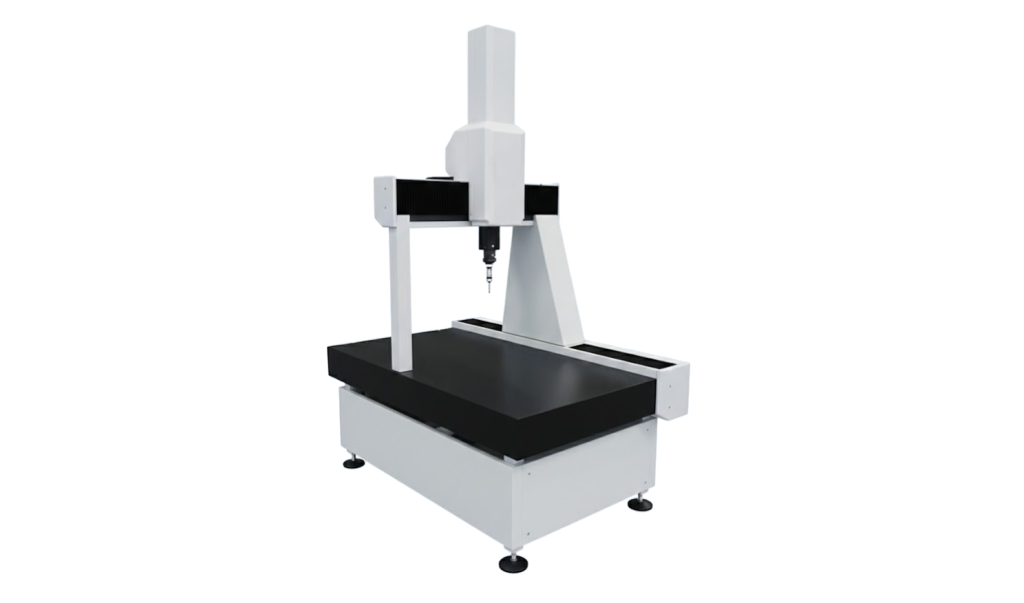
What have we learned so far? Speed and acceleration both affect accuracy, but in different ways. Speed influences how the probe behaves on the surface, while acceleration influences how the machine structure deforms during motion. Acceleration usually has the greater overall impact on dimensional accuracy, because it physically changes the geometry of the machine.
Speed-related errors can often be reduced through probe calibration. Acceleration-related errors require structural control or reduced dynamics.
How do different CMM architectures behave in light of this? Each one reacts differently to acceleration and structural load.
| Structure | Typical sensitivity | Main dynamic effect |
|---|---|---|
| Moving table | Low | The part moves with the table: heavier parts mean higher moving mass |
| Moving bridge | Moderate | Bridge yaw when accelerating along its travel axis, Z-ram bending |
| Gantry | Moderate | Torsion of the cross-beam between the two rails |
| Horizontal arm | High | Bending and torsion of the arm |
| Cantilever | Very high | Bending of the unsupported beam |
Acceleration always reveals a machine’s weakest stiffness direction, showing where the structure is most likely to deform under dynamic load.
The 5-axis advantage
Traditional CMMs must move and accelerate heavy bridges and rams to reach each feature. 5-axis heads change this: with Renishaw PH20, the head itself performs the touch, rotating to take points while the CMM structure barely moves. With REVO, the same principle extends to continuous scanning, with the head moving the stylus along the surface while the machine follows a slow, steady path.
The immediate benefit is lower linear acceleration: the heavy structure remains almost static, with minimal deformation.
The second benefit is much higher measurement speed. Fast head rotation reaches high path velocities with negligible inertial load, and vibrations drop sharply because far less mass is in motion, so there is almost no resonance excitation.
With REVO in particular, the active head control compensates stylus deflection in real time, keeping the probing conditions stable. Scanning speed can therefore be increased significantly while preserving accuracy: a well-tuned 5-axis system can scan several times faster than traditional analog scanning probes while maintaining, or even improving, form accuracy.
Dynamics in your measurement program
Everything we have described comes down to a few parameters: travel speed, measuring speed, scanning speed, acceleration and approach distance. In a DMIS program these are not hidden machine settings. They are explicit statements in the program itself: FEDRAT for speeds, ACLRAT for accelerations, SNSET for approach and retract distances.
Because TouchDMIS is built on the DMIS standard (ISO 22093), the dynamic choices behind every measurement are part of the program. They can be read, reviewed and reused, and they travel with the program from one machine to another.
The same logic applies to calibration. With the Tools Manager, probe and stylus data are managed in one place, so the conditions used at calibration stay consistent with the conditions used during inspection.
And when throughput matters, TouchDMIS supports 5-axis heads natively: PH20 for fast head-touch probing and REVO for 5-axis continuous scanning, letting the head do the fast moves while the CMM structure stays calm.
Five rules for dynamic-aware CMM programming
- Calibrate at the speed you measure, for both touch-trigger and scanning probes.
- Use maximum speed only for long travel moves.
- Allow a short settling time after strong decelerations, before any touch or scan.
- Slow down on small radii and wavy profiles: acceleration grows with the square of speed.
- Let a 5-axis head do the fast moves, so the CMM structure can stay slow and steady.
Conclusion
In metrology, dynamics are not a secondary detail: they are a core parameter of any high-performance CMM strategy. Two habits make the biggest difference: calibrate at the speed you measure, and keep acceleration under control before every touch or scan. Combine that with a 5-axis head and you can raise throughput substantially without giving up measurement integrity.
Want to see how TouchDMIS handles PH20 and REVO? Book a demo.
PH20, REVO, SP25 and SP80 are trademarks of Renishaw plc.